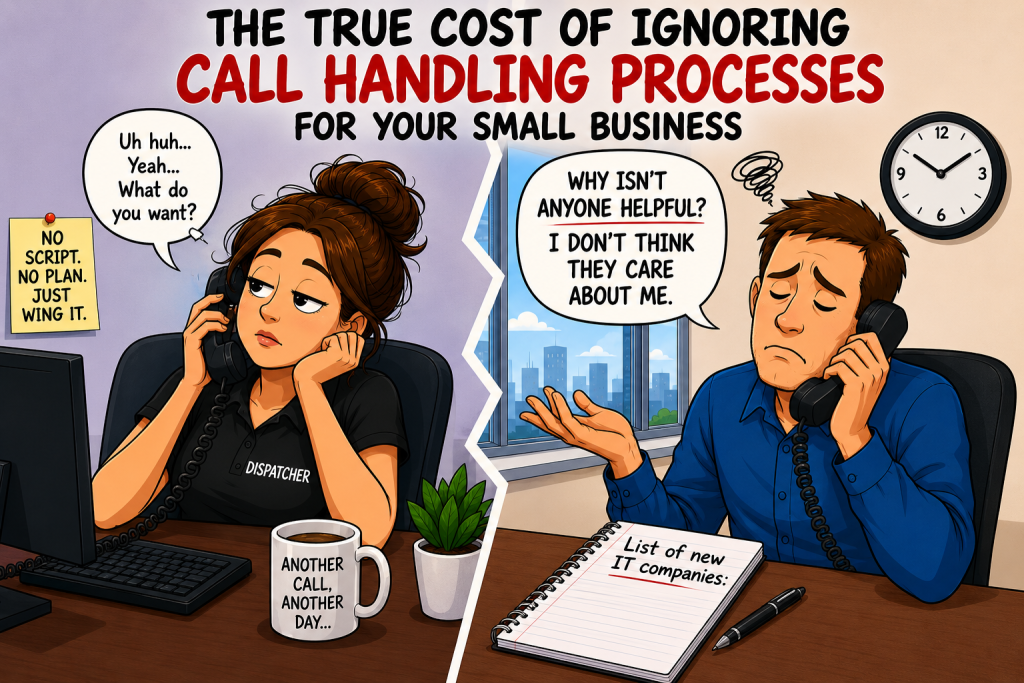
What happens when your team wings it on the phone and how documented scripts and triage procedures can restore trust and improve client satisfaction.
There are moments in business that humbly remind you that good intentions do not equal good experiences. I had one of those moments when my IT company lost a client, not because we could not solve the technical problem, but because of how we communicated. The feedback stung. Our tone felt apathetic. Our responses felt inconsistent. Our phone interactions lacked structure and clarity. What we believed was casual and flexible showed up to the client as disorganized and uncaring.
As a leader, it would have been easy to defend the team or blame a difficult client. Instead, I chose to own it. When communication feels scattered, it is rarely the fault of one person. It is usually a system problem. In our case, we had no system. Each team member picked up the phone and handled calls based on their own instincts. Some were warm and detailed. Others were brief and transactional. Some asked the right questions. Others rushed to solutions. There was no shared playbook, no consistent language, and no clear path for triaging calls.
When there is no standard, the client experience becomes unpredictable. And unpredictability erodes trust.
That realization pushed me to create something we should have had from the beginning. I sat down and built a Phone Script and Triage Procedure document. Not a rigid script that strips away personality, but a structured guide that ensures every client receives the same level of clarity, professionalism, and care. I wanted every call to reflect our brand, regardless of who answered the phone.
The document outlined specific language for greeting clients in a way that felt warm and confident. It included responses to common questions so no one was left guessing or improvising under pressure. It defined how to ask clarifying questions so we could fully understand the issue before reacting. It also mapped out when a call should be transferred, what to say during that transition, and exactly which person or department should receive it.
This was not about scripting robots. It was about eliminating confusion.
One of the biggest shifts came from the triage process.
Before, our calls were often passed around because no one was quite sure where they belonged. Clients would need to repeat themselves, growing more frustrated with each handoff. With a clear procedure in place, our team could identify the nature and urgency of the issue quickly and route the call correctly the first time. That one change alone improved the client experience dramatically.
What surprised me the most was the impact on the team. When people know what is expected of them and have the tools to deliver, confidence grows. Instead of wondering what to say or worrying about saying the wrong thing, they can focus on listening and helping. The consistency also created a stronger sense of unity. We were no longer a group of individuals handling calls in different ways. We became a coordinated team delivering one cohesive experience.
The results spoke for themselves. We saw less confusion internally. Our clients experienced smoother, more professional conversations. Satisfaction levels improved. Retention followed. And perhaps most importantly, our brand began to feel consistent again.
There is also a financial reality that many business owners overlook. In my IT company, I calculated that it costs over $900 just to get the phone to ring. Marketing, advertising, time, effort, all of it adds up. I also figured out that it costs over $20,000 to close a new deal.
What does it cost your business to get the phone to ring?
Think about it this way. If your team is inconsistent on the phone, you are essentially gambling with every lead. Some calls will go well. Others will miss the mark. Over time, that inconsistency quietly chips away at growth.
Standardizing communication is not about removing authenticity, it’s about protecting your client experience. It ensures that no matter who answers the phone, your brand shows up clearly, confidently, and consistently.
If you’re a small business leader and you have not documented how you want your team to handle calls, this is your invitation to stop leaving it to chance. You do not need a perfect system to get started. Start here:
- Define your expectations
- Document your preferred responses
- Map out your processes
- Give your team a guide they can rely on and update it regularly
Communication is one of the most visible parts of your brand.
Why leave that to chance?
Need help creating and introducing standard phone scripts and procedures to your team? I’m here to help! Schedule a discovery call today and learn how I can help.