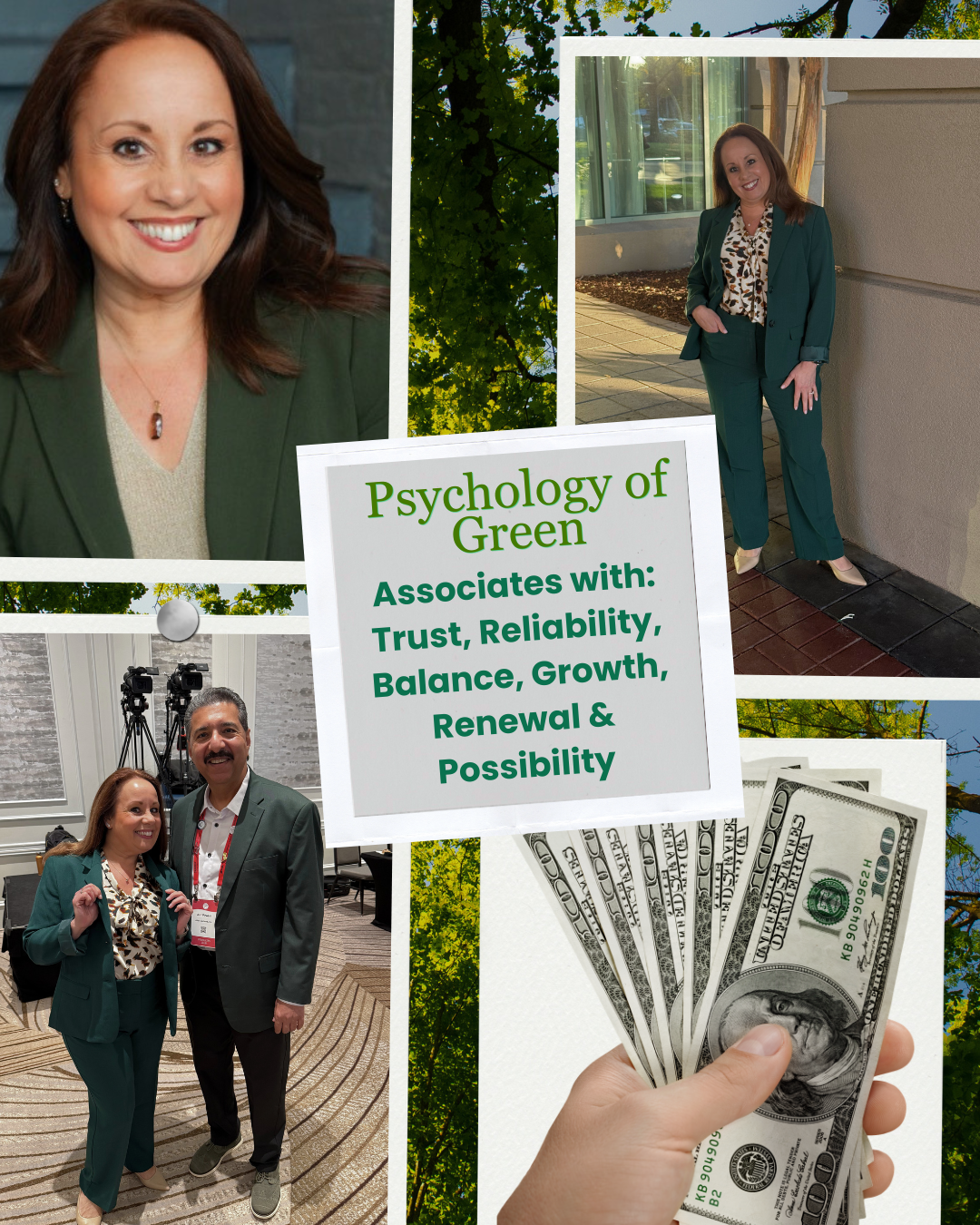
Last week, I attended TMT’s Q4 Producer’s Club meeting. On day 2, I wore a deep green pantsuit. This suit sparked quite a bit of attention. So many colleagues stopped me to say, “I love that green.” Some commented on the color before they commented on the conversation we were having. Others mentioned it as they walked by. It made me smile and think about something I talk about often in my executive presence workshops: color communicates long before we do.
Most people spend time thinking about what they are going to say at a meeting, presentation, networking event, or conference. Far fewer think strategically about the message their clothing is sending before they ever open their mouths. Yet color psychology tells us that people form impressions in seconds, and color plays a meaningful role in perception.
I have always thought green is one of the most interesting colors in business because it blends qualities that seem contradictory at first glance. Do you agree? It is calming, yet confident. It is approachable, yet professional. It stands out without screaming for attention. That balance is exactly why green can be a secret weapon in your professional wardrobe.
Research on color preferences consistently places blue and green among the most preferred colors worldwide. While blue often gets credit for communicating trust and reliability, green carries many of those same positive associations while adding a sense of balance, growth, renewal, and possibility. Think about where we see green in nature. It surrounds us in healthy forests, growing gardens, and vibrant landscapes. Our brains have developed positive associations with green over thousands of years.
Think of a time when you saw someone wearing green, did you perceive that individual as either balanced, stable, grounded, and/or emotionally intelligent? Green does not typically trigger the feelings of urgency that red can create or the formality that black sometimes projects. Instead, it sends a message of steady confidence.
That’s particularly fascinating when we consider executive presence. Many professionals believe they need to wear navy, charcoal, or black to be taken seriously. While those are certainly strong business colors, green offers something unique. It suggests confidence without appearing rigid. It demonstrates authority while maintaining approachability.
Color acts as a conversation starter, an attention-getter, and often a memory marker.
People remembered me. They remembered the suit. They remembered our conversation. That’s the power of strategic image management.
Another interesting aspect of green is how it makes us feel personally. Numerous studies in environmental psychology have found that exposure to green environments is associated with reduced stress and improved feelings of well-being. I know wearing a green blazer is not the same as taking a walk through a forest, many people report feeling calmer and more centered when wearing shades of green.
I often remind clients that executive presence is not only about how others perceive you. It is also about how you feel when you enter a room. If a color helps you feel composed, focused, and authentic, that confidence often becomes visible to others. The psychology works both externally and internally.
When should you strategically wear green in business?
- One ideal situation is networking events and conferences. If you’re attending a trade show, industry conference, chamber event, or professional association meeting, green helps you stand out from the sea of navy and black suits. It gets noticed in a sophisticated way, making you more memorable without looking like you’re trying too hard. See images of me and my colleague Ash above!
- A second opportunity is during collaborative meetings. Green is associated with harmony, balance, and growth. If you’re facilitating strategic planning sessions, conducting workshops, leading brainstorming discussions, or managing cross-functional teams, green can subtly reinforce a collaborative and forward-thinking image.
- A third situation is client-facing meetings where trust and relationship-building matter. Consultants, financial advisors, human resource professionals, coaches, trainers, and business leaders often need to project competence while remaining approachable. Green helps communicate both qualities simultaneously.
Not all greens send the same message, however.
- Dark emerald green, like the suit I wore at the conference, communicates sophistication, executive presence, and confidence. This is an excellent choice for presentations, leadership roles, conference speaking engagements, and important business meetings. It offers authority without feeling severe.
- Forest green like my colleague’s blazer above, conveys stability, reliability, and maturity. It works particularly well in professional services, financial industries, healthcare, law, and consulting environments where credibility is paramount.
- Olive green like my blazer in my headshot for my book, projects practicality and groundedness. It often feels less formal and more conversational. This shade can work beautifully for workshops, team meetings, client lunches, and business casual environments.
- Sage green creates a softer, calming impression. It communicates warmth and accessibility and is especially effective in coaching, education, wellness, and relationship-driven professions.
- Bright greens and lime greens communicate energy, creativity, and innovation. While these shades can be highly effective in creative industries, marketing, design, and technology startups, they generally require more thoughtful styling in conservative corporate environments.
The key is matching the shade to the message you want to send and the audience you want to influence.
One of the biggest mistakes professionals make is assuming executive presence comes solely from experience, expertise, or title.
Those certainly matter. Yet executive presence is also shaped by communication, body language, grooming, attire, and color choices. Every element contributes to the story people tell themselves about you before you have the opportunity to tell your own story.
That green suit reminded me of something I teach regularly: image is not superficial. Image is communication. Every choice we make either reinforces our professional brand or creates confusion around it.
When people repeatedly said, “I love that green,” they weren’t simply complimenting fabric. They were responding to a message. The color projected confidence, approachability, professionalism, and energy. Those qualities aligned with how I wanted to show up at the conference.
So if you have a green outfit hanging in your closet, consider giving it a try at your next business event. You just might discover t
hat sometimes the color that gets the compliments is also the color that helps create meaningful connections.
That’s the real power of color psychology.
Want to learn more about which colors enhance your brand and business? Let’s work together!
If you are curious about how your wardrobe, communication style, body language, and personal brand are influencing the way others perceive you, I’d love to help. In my Executive Presence Workshops, available for both individuals and teams, we explore the psychology behind professional image, leadership presence, personal branding, and strategic communication.
Whether you’re preparing for a leadership role, building client relationships, elevating your visibility, or helping your team strengthen its professional impact, understanding how to align appearance with influence can be transformational. The goal is not to change who you are. The goal is to ensure your professional presence reflects the value and expertise you already bring to the table.
Lisa Shorr is a Certified Image Consultant, Business Communication Coach, Co-Owner of a thriving MSP, and best-selling, award-winning author of Your B.R.A.N.D. Unleashed: 9 Proven Strategies That Build Trust and Maintain Lasting Client Loyalty. With over two decades in the IT industry, Lisa specializes in helping MSP and small business owners and leaders develop their executive presence, improve client retention, and become trusted authorities in their field. Through her proven B.R.A.N.D. Method and high-impact coaching programs, Lisa transforms technical teams into confident, client-focused professionals who lead with clarity, connection, and confidence.